Why Your Lash Retention Is Bad and How to Fix It
Why Your Lash Retention Is Bad and How to Fix…
Why Your Lash Retention Is Bad and How to Fix It
If you are a lash artist struggling with lash retention, you already know how frustrating it can be.
Your client leaves happy. The set looks beautiful. Everything feels perfect.
Then a few days later you get the message.
“My lashes are falling out.”
And immediately your stomach drops.
You start questioning everything. Your adhesive. Your prep. Your technique. Even yourself.
If you have been wondering why your lash retention is bad and how to fix it, this post is going to walk you through the real causes and the practical solutions that actually make a difference.
Bad retention is not random. It is almost always fixable once you understand what is really happening.
Let’s break it down.
First, What Is Considered Good Lash Retention?
Before we diagnose the problem, we need to define the goal.
Healthy natural lashes shed daily. On average, clients lose two to five natural lashes per eye per day. That means some shedding is normal and expected.
Good lash retention typically means:
Clients returning at two to three weeks with at least forty to fifty percent of extensions still intact
Minimal premature fall out within the first week
Extensions shedding with the natural lash attached, not sliding off clean
If clients are losing a large percentage within the first few days, that is a retention issue.
The Most Common Reasons Your Lash Retention Is Bad
1. Improper Lash Prep
Prep is one of the most overlooked steps, especially for beginner lash artists.
If natural lashes are not completely clean, oil free, and free of makeup residue, the adhesive cannot bond properly.
Common prep mistakes include:
Not thoroughly cleansing the lashes
Skipping primer
Not allowing lashes to fully dry before application
Rushing the process
Even small amounts of oil can break down adhesive bonds quickly.
If your retention is inconsistent, evaluate your prep routine first.
2. Incorrect Adhesive Use
Adhesive is chemistry. And chemistry does not guess.
If your adhesive is too slow or too fast for your environment, retention will suffer.
Common adhesive issues include:
Using adhesive that dries too quickly for your speed
Using adhesive that dries too slowly and causes weak bonds
Not replacing adhesive drops frequently
Using expired adhesive
Many artists are never properly taught adhesive theory. They are told to use a specific brand without understanding humidity, temperature, and cure time.
Adhesive performance is directly affected by your room conditions.
3. Poor Humidity and Temperature Control
Your lash room environment matters more than you think.
Most adhesives perform best within a specific humidity and temperature range. If your room is too dry or too humid, bonding issues occur.
If humidity is too low, adhesive cures too slowly and creates weak bonds.
If humidity is too high, adhesive can cure too quickly before wrapping properly around the natural lash.
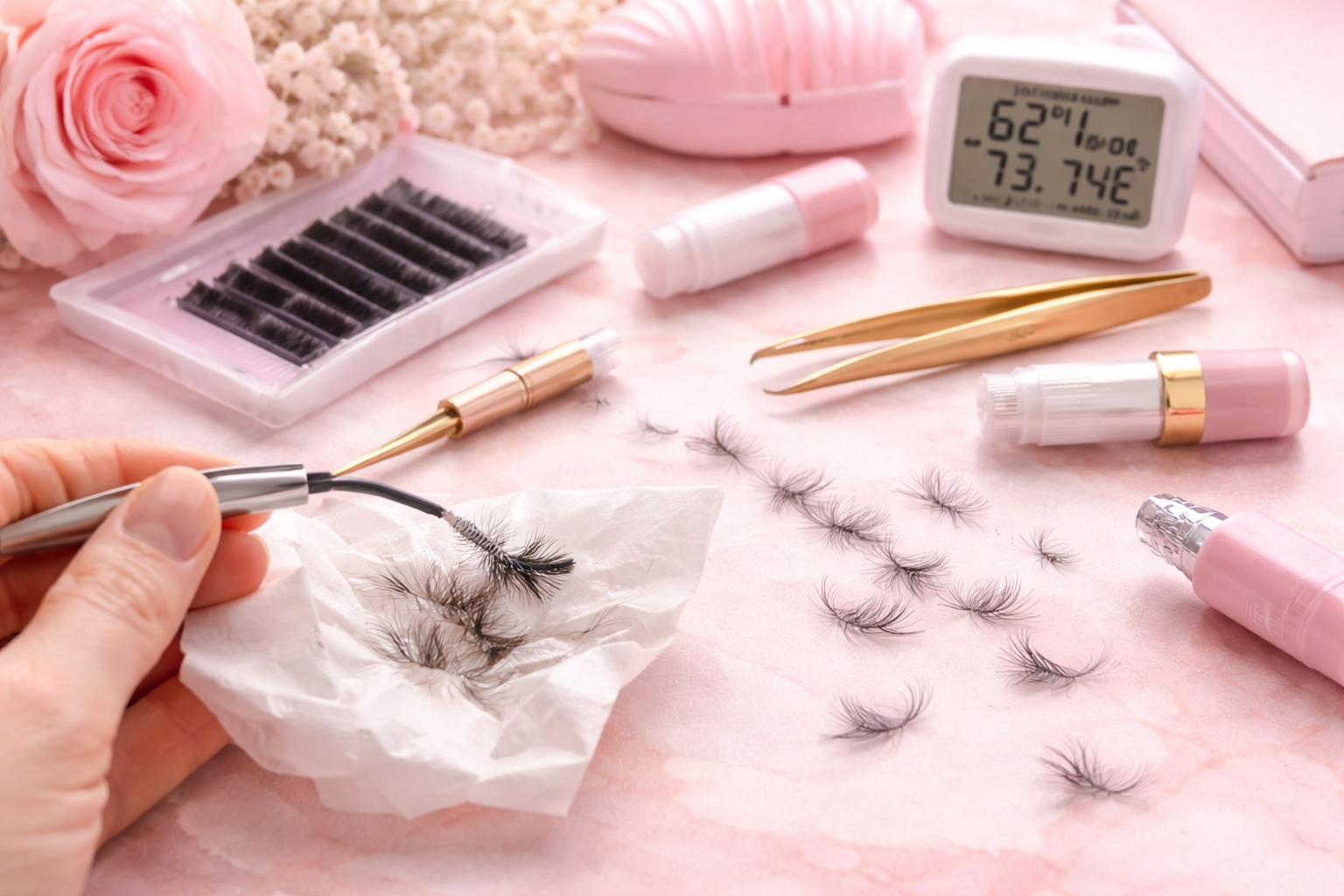
Every lash artist should be using a hygrometer to monitor room conditions. Guessing is not a strategy.
4. Incomplete Isolation
Isolation is not just about preventing stickies. It directly affects retention.
If extensions are attached to multiple natural lashes, the shedding cycle becomes compromised. When one natural lash sheds, it can pull another extension with it prematurely.
Poor isolation can cause:
Premature fall out
Client discomfort
Damage to natural lashes
If clients complain about lashes feeling heavy or painful, isolation may be part of the issue.
5. Not Enough Adhesive or Too Much Adhesive
Both extremes create problems.
Too little adhesive results in weak attachment points. The extension may slide off clean without the natural lash attached.
Too much adhesive creates bulky bonds that do not cure properly and can lead to poor retention.
The correct amount creates a smooth bond that wraps and locks onto the natural lash.
This is something that improves dramatically with proper technique training.
6. Placement Issues
Where you place the extension matters.
Extensions placed too far from the lash line can lose stability.
Extensions placed too close can cause irritation and improper attachment angles.
Proper placement creates a strong bond and comfortable wear.
7. Client Factors
Not all retention issues are technical.
Some clients:
Use oil based products
Sleep on their face
Skip aftercare instructions
Have extremely oily skin
Experience hormonal changes
Education is part of retention. If clients do not understand proper aftercare, even perfect application can suffer.
Clear aftercare instructions and realistic expectations are essential.
How to Fix Lash Retention Fast
Now let’s focus on solutions.
Tighten Your Prep Routine
Create a non negotiable prep system.
Cleanse thoroughly. Rinse completely. Dry fully. Prime when appropriate. Make sure lashes are ready before applying extensions.
Consistency matters.
Learn Adhesive Theory
If you do not fully understand how adhesive interacts with humidity and temperature, that is likely a gap in your education.
Know your adhesive cure time. Adjust your speed accordingly. Replace glue drops every fifteen to twenty minutes. Store adhesive properly.
This alone can dramatically improve retention.
Control Your Environment
Invest in a hygrometer. Monitor humidity and temperature daily.
If needed, use a humidifier or dehumidifier to stay within your adhesive’s optimal range.
Environment control separates hobbyists from professionals.
Improve Isolation and Placement
Slow down if necessary.
Clean isolation leads to better retention. Clean placement creates stronger bonds.
Quality always beats speed.
Educate Your Clients
Give clear aftercare instructions verbally and in writing.
Explain normal shedding. Explain what is not normal. Set realistic refill schedules.
Retention is a partnership between artist and client.
Why Many Lash Artists Struggle With Retention
Here is something most artists do not want to admit.
Many beginner courses rush through retention theory.
You are shown how to place lashes, but not why bonds fail. You may not be taught detailed adhesive science, humidity control, or troubleshooting methods.
That is not your fault.
If your retention is inconsistent, it may simply mean your training was incomplete.
At LucyLu Lash Academy, we go far beyond basic application.
We teach detailed retention theory, adhesive behavior, environmental control, isolation refinement, troubleshooting techniques, and advanced application methods.
We break down why retention fails and how to fix it in real time.
Whether you are a new artist or already certified and struggling, we offer:
A full lash certification course that dives deeply into retention science and technique
A refresher lash course designed for artists who want to fix retention problems and elevate their skills
Advanced troubleshooting support
Many of our students come to us specifically because their retention was not where it needed to be. Once they understand the technical details, everything changes.
Better retention means happier clients. Happier clients mean more referrals. More referrals mean a fully booked schedule.
Retention is income stability.
Is It Worth Investing in Better Training?
If clients are not returning because retention is poor, you are losing repeat revenue.
Ask yourself:
How many refills have you lost this month
How much confidence has poor retention taken from you
How many potential referrals disappeared
Fixing retention is not just about technique. It is about building a reliable business.
Proper education pays for itself quickly.
Final Thoughts
If your lash retention is bad, it does not mean you are not talented.
It means there is a technical gap somewhere.
And technical gaps can be fixed.
With the right knowledge, the right environment, and the right training, you can consistently achieve two to three week retention and beyond.
If you are ready to stop guessing and start mastering your retention, we would love to help you level up.
Learn more about our full lash certification or our refresher course designed specifically for artists who want stronger retention, stronger technique, and stronger income.
Call or text 773 870 2816 with any questions about our courses. We are happy to guide you toward the best option for your goals.
You deserve clients who return consistently and trust your work.
And it starts with mastering retention the right way.